Turn certificate chaos
into Certificate Intelligence.
The certificate that breaks you is the one you didn't know existed.
[cyphrs] Scout shows what certificates are actually doing across your estate: which are live, which are only issued, what has changed, what is unmanaged, and what needs action.
Not just another static inventory. Live, evidence-backed conclusions operators can trust. Start with agentless discovery, then add continuous monitoring as your estate comes into view.
Early access is free. We're working with a small number of teams to shape the platform.
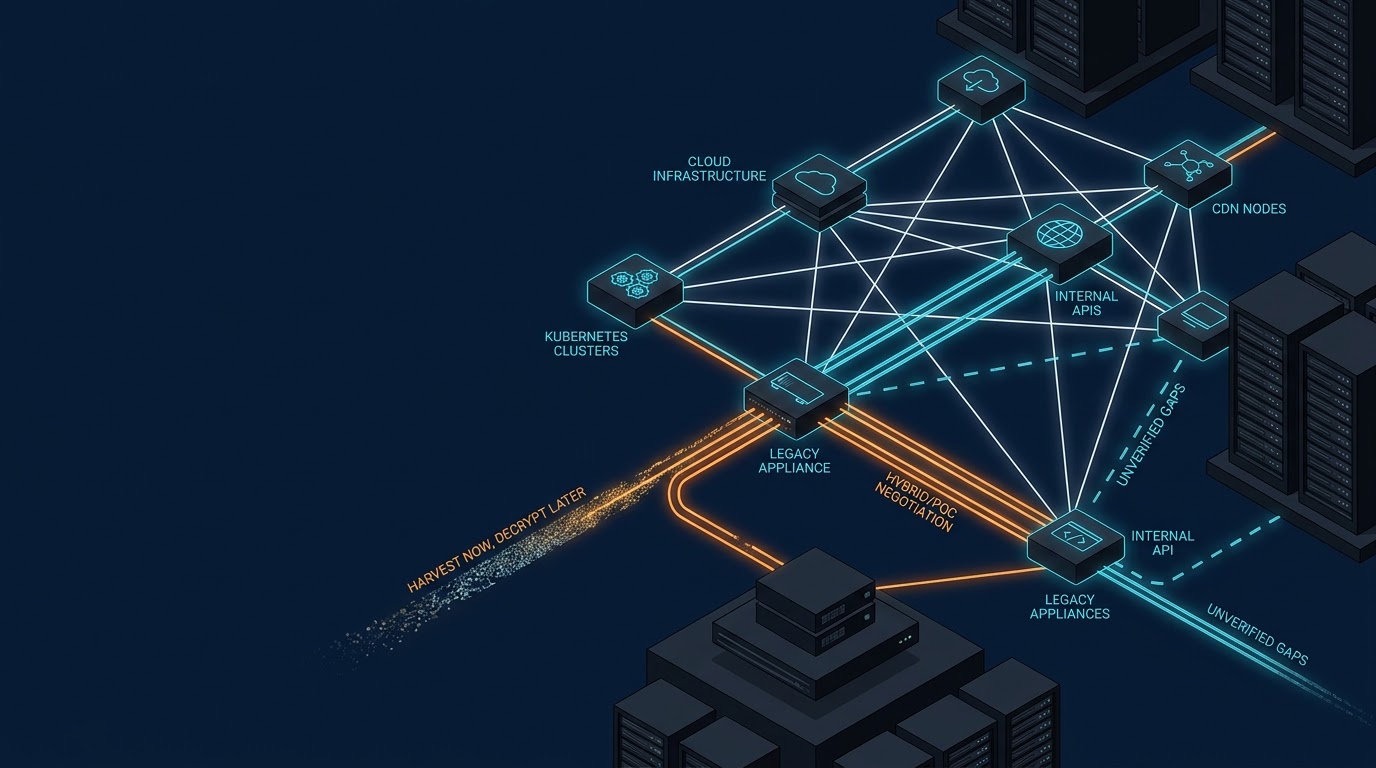
Quantum risk starts with the cryptography you cannot see.
The visibility problem does not stop at certificates. Post-quantum cryptography (PQC) migration starts by finding the services, protocols, trust anchors, third parties and legacy systems that still depend on quantum-vulnerable cryptography.
[cyphrs] PQC Discovery extends the same evidence discipline behind Scout: distinguish capability from what is offered, negotiated and proven; identify harvest-now-decrypt-later exposure; and make missing coverage explicit.
Map dependencies
Find HNDL exposure
Prove PQC posture
Certificate incidents do not start with expiry.
They start with uncertainty.
Most teams do not fail because they forgot to sort a spreadsheet. They fail because they cannot prove what is live, who controls it, whether renewal works, or what changed since the last check.
A certificate is serving production traffic, but nobody knows who owns it, where it is deployed, or how it renews.
Certificate Transparency (CT) logs prove a certificate was issued. They do not prove it is live. Teams chase weak signals while real endpoints stay unmanaged.
A certificate is valid today, but nobody can prove whether ACME, cert-manager, a CDN, or a script will renew it tomorrow.
A load balancer, ingress, CDN, or appliance presents an old, default, mismatched, or unmanaged certificate.
External users, internal systems, regions, or customer networks may see different certificates, chains, or TLS posture.
One wildcard or shared certificate quietly supports many services, so one renewal failure or key issue breaks more than expected.
Internal systems using public PKI can advertise names, services, and architecture through public issuance records, giving competitors and attackers unnecessary insight while forcing private infrastructure onto public renewal cadences.
PCI-DSS, NIST, eIDAS, NIS2, SAMA, UAE IAS, and Qatar NIA all ask whether transport crypto is properly controlled. Policy says what should be true. [cyphrs] Scout shows what live endpoints can prove.
This is not a list problem. It is a certificate certainty problem.
See your complete certificate picture.
Live. Evidence-backed. Actionable.
Statement-first, evidence-backed
Every statement has a path to supporting evidence. See why before you act.
A certificate in CT logs, or sitting on disk, is not proof it is being served. [cyphrs] Scout verifies what is actually presented on the wire.
A found record is a lead. A proven endpoint is a fact. [cyphrs] Scout separates weak evidence from action-ready evidence.
What the outside sees and what the inside sees can differ. [cyphrs] Scout keeps those views distinct and flags client variance.
A scan tells you what was true then. Monitoring tells you when the CA, served certificate, renewal state, or TLS posture changes.
What Certificate Intelligence
gives back to the business.
[cyphrs] Scout turns certificate management from reactive firefighting into evidence-backed operations.
Know which certificates are live, unmanaged, close to expiry, or serving from the wrong place before customers find out.
Separate issued-only records and weak signals from verified endpoints that actually need work.
Rank action by live status, renewal control, TLS posture, trust path, and blast radius, not expiry date alone.
Give security, audit, and customer teams evidence of what is monitored, what changed, and what actions were taken.
Reduce the constant, increasing cycle of certificate renewal and remediation firefighting so infrastructure teams can get back to higher-value work.
Move verified endpoints into monitoring, renewal workflows, public automation, private PKI, or managed service delivery.
Certificate Intelligence
for regulated environments.
For regulatory frameworks such as PCI-DSS and HIPAA, [cyphrs] Scout helps teams show what certificate and TLS controls are actually in place, what failed, and what still needs attestation.
Run [cyphrs] Scout once, then use the same live certificate evidence to support the compliance views different customers, sectors, and auditors ask for.
Show whether an endpoint is compliant, non-compliant, attestation-required, or not applicable, with the requirement and triggering finding behind each verdict.
Different customers, regions, and regulated systems can require different certificate rules. [cyphrs] Scout helps show whether each endpoint meets the standard that applies to it.
[cyphrs] Scout separates proven certificate evidence from assumptions, so teams can show what is verified and clearly mark what still needs human attestation.
See what's REALLY out there.
Run [cyphrs] Scout. Get a complete, evidence-backed picture of every certificate – and exactly what to do about it.
Early access is free. We're working with a small number of teams to shape the platform.
Start with [cyphrs] Scout. When you know what is live, unmanaged, misconfigured, or changing, [cyphrs] Hub gives you the path forward: monitoring, renewal automation, public certificate workflows, and private PKI adoption across Kubernetes, SCEP, EST, AD CS, Vault, cert-manager, CDNs, WAFs, and load balancers.